dAS Festival 2026: technical direction and Le Sacre du Printemps with sixty-two loudspeakers
Four days of dance, music and the spoken word in a dozen venues across Piacenza. We handled the technical direction, and were inside the evening that put the audience in the orchestra’s place: Xavier Le Roy’s Le Sacre du Printemps.
From 17 to 20 September 2026 Piacenza hosted the fourth edition of the dAS Festival, conceived and directed by Riccardo Buscarini for the association De Arte Saltandi. The title was Tema e Variazioni (Theme and Variations): the classics, and what happens when someone takes them up again.
Gianmarco Romiti was responsible for its technical direction. That means something simple to say and long to do: that every event finds its space ready.
A dozen venues, no two alike
An auditorium, the atrium and first floor of a Rationalist secondary school, a sports hall, the greenhouse and lawn of a palazzo, a gallery, two theatres, a library, a deconsecrated Baroque church, the Conservatory’s hall, a hall of honour. In four days they saw concerts, dance duets, talks, an evening of video dance with an international jury, and a concert of electronic music to close.
Every venue calls for a different system and has different rules: where things can be hung, where the power runs, how much time there is between one show and the next. Technical direction is the table that holds all this together, and the people who make sure it is followed.
Le Sacre du Printemps, with the audience in the orchestra’s place
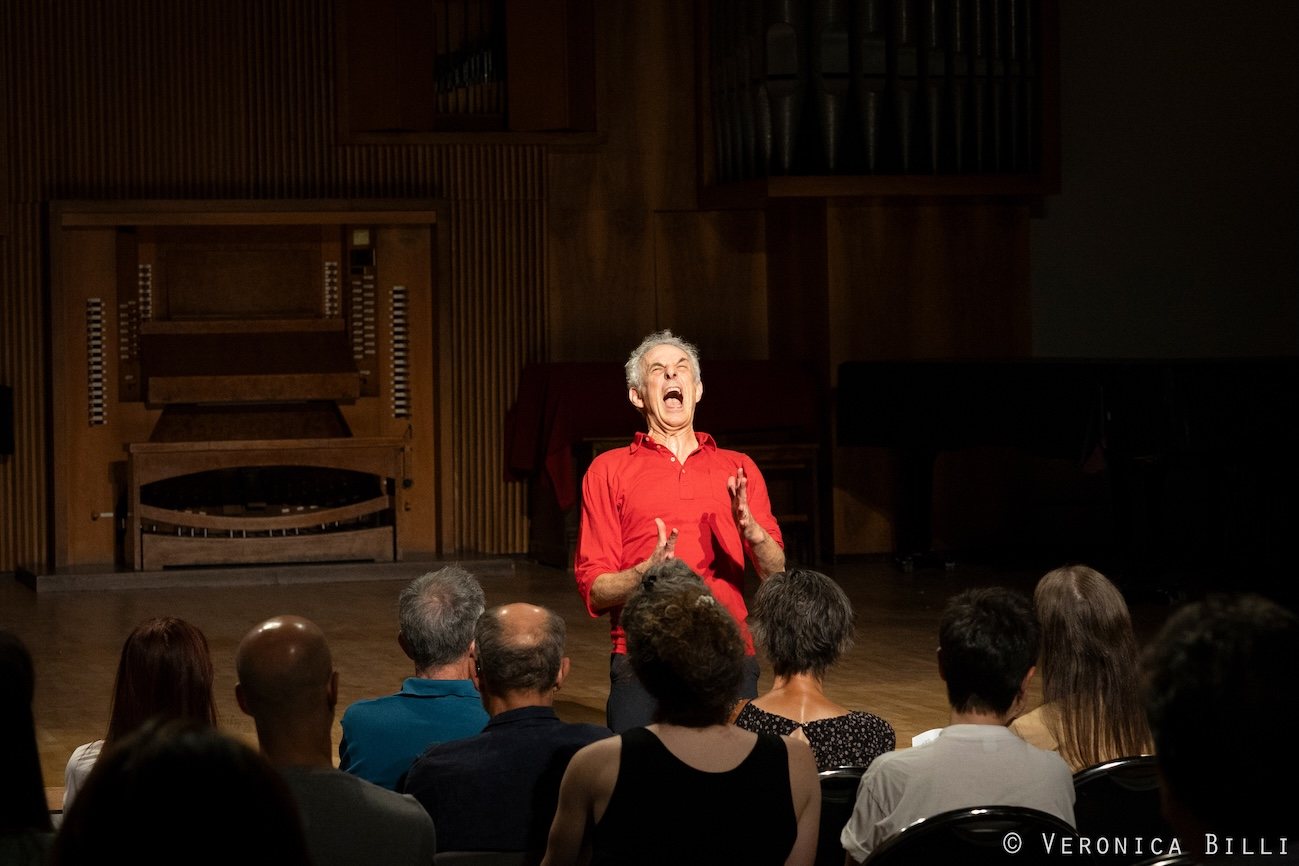
On Sunday 20 September at 7 pm, the hall of the Nicolini Conservatory hosted Le Sacre du Printemps by Xavier Le Roy, created and performed by him, in the twentieth year since its creation. It is the event we co-curated: the programme presents it “in collaboration with Conservatorio G. Nicolini and XNL Musica, thanks to Maestro Roberto Solci and Gianmarco Romiti”.
The piece was born in 2007. Le Roy studied the gestures of Sir Simon Rattle rehearsing Stravinsky’s Rite of Spring with the Berliner Philharmoniker, and performs them facing the audience, as if the audience were the orchestra. The seats are arranged like the musicians’ places. The music, the Berliner’s recording under Rattle, does not come from two speakers at the sides: it comes from loudspeakers lying on the floor and placed under the seats, so that each member of the audience hears the part played by whoever would sit in their place. In the original sound design, by Peter Böhm, there are forty-eight of those points.
Sixty-two loudspeakers in a historic hall
To make it sound at the Nicolini we fielded sixty-two loudspeakers, subwoofers included. A very large project, and almost our whole audio fleet on the floor:
- forty-eight Achat 104s, the compact speakers under and between the seats: one for each point of the orchestra;
- eight Achat 110s, four Achat 208s and the subwoofers, for the body of the sound in the hall;
- ten four-channel amplifiers for the compact speakers, the amplifiers for the tops and subs, the system processor;
- two twelve-unit racks and the power cable, cut and terminated by us.
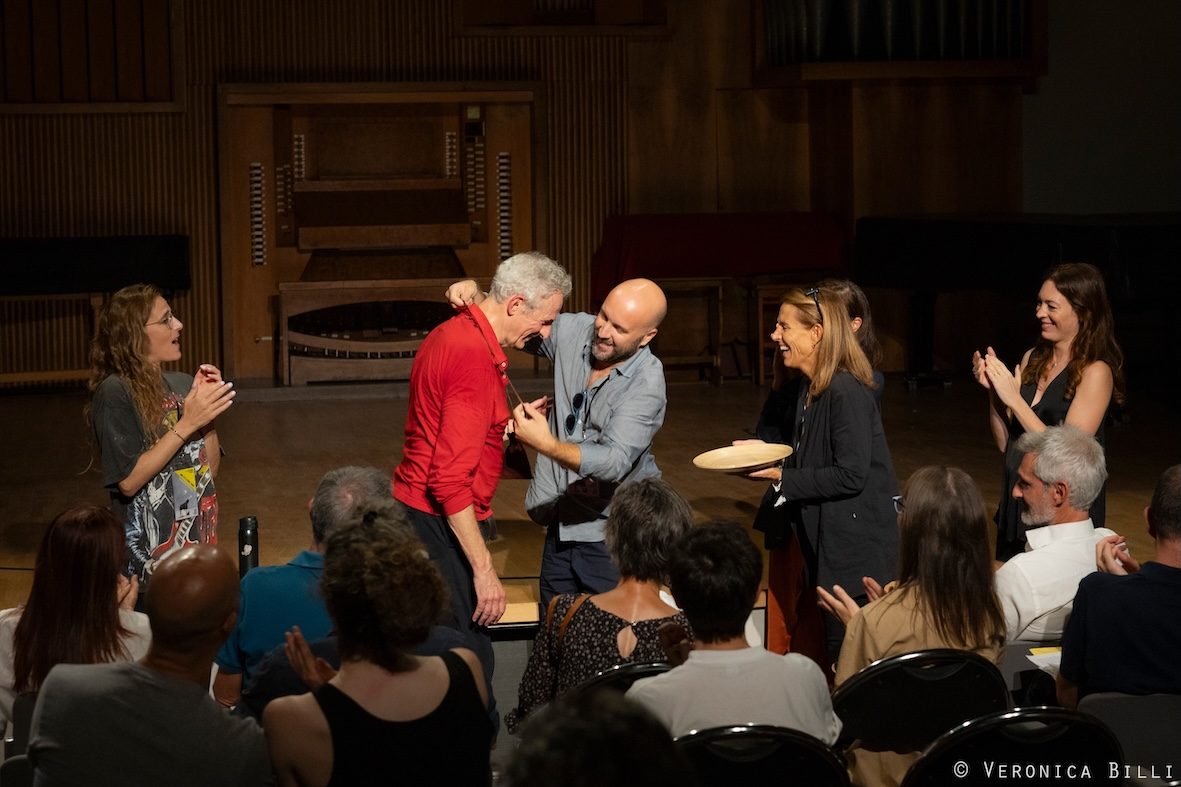
At the end of the evening the festival presented Le Roy with the Moneta d’Oro per l’Innovazione Coreografica (Golden Coin for Choreographic Innovation), new this year.
What we take home
A sixty-two-loudspeaker system rigged and tuned inside a historic hall, on the closing day of a festival with other events around town. The compact-speaker part is the same configuration you will find in the audio service configurator, under Installation and exhibition: now we know from experience what it takes, in time and in cable.
Renzo Francabandera wrote about it in Paneacquaculture, in Italian.
Photos: Veronica Billi.